

Read this article in another language
Links refer to this article. Existing localized editions may differ from the source. Unavailable languages are not translated pages.
Cute versus spooky is a merchandising decision tied to a named style mix.
Halloween style references
| Role | Reference | Recorded fact | Display question |
|---|---|---|---|
| Cute / character | RIVO-HW26-010 Pumpkin Jelly | 100 g / 144-carton reference | Does the size fit the counter tray? |
| Spooky / novelty | RIVO-HW26-009 Halloween Monster | 4-design reference; 144/carton estimated | Does the finish need a close-up sample? |
| Blind-box test | RIVO-HW26-012 | 200 g / 144-carton reference | How will the sealed unit be displayed? |
Approve the actual colour, finish and package before choosing the cute/spooky mix. Request a Halloween mix.
A Halloween squishy assortment should have a recognizable point of view. Cute ghosts, rounded pumpkins and more dramatic skull designs can all fit the season, but combining every style in one display makes it harder for a shopper to understand the range. Choose the audience and mood first, then use samples to decide which products belong together.
On this page
- Halloween style references
- Define cute and spooky in observable terms
- Compare two identified catalog references
- Connect the mood to a specific shop context
- Build a small sample scorecard
- Separate character variety from stock depth
- Avoid unclear seasonal positioning
- Create the final visual brief
- Continue planning your Halloween order
The RUIWO Halloween collection provides character references for shortlisting. A character name or friendly expression does not establish an age grade; suitability still depends on the exact product information.
Define cute and spooky in observable terms
Instead of telling a factory to make the assortment less scary, identify the visual differences you mean. A rounded outline, large eyes and a simple smile communicate a different mood from sharp-looking graphics, exposed teeth or a dark skull treatment.
Write the criteria against reference images. Useful fields include facial expression, silhouette, decoration, dominant color and graphic intensity. Keep the review focused on appearance: a visual score cannot verify material, durability or product safety.
The Cute Ghost Squishy and Halloween Skull Squishy give buyers two distinct catalog references to compare. Confirm the current physical versions before approving a display built around their images.
Compare two identified catalog references
| Cute Ghost — RIVO-HW26-004 | Skull Crunchy — RIVO-HW26-011 |
|---|---|
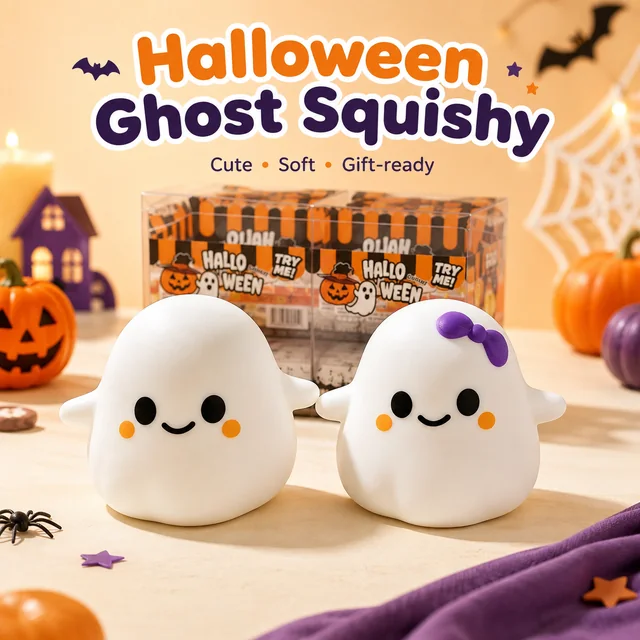 |  |
| Review the expression, outline and white body against the planned display. | Review skull details and the selected color against the same visual brief. |
These existing catalog images identify the two product families. Their physical scale and lighting are not matched, so equal column widths do not mean equal toy sizes. Use them to choose a visual direction; photograph the actual samples together for a size or shelf-space comparison. Neither image establishes age grading, safety or likely sales.
Connect the mood to a specific shop context
A gift shop with a soft, playful visual identity may favor rounded characters and a restrained palette. A Halloween specialist may have room for a separate, more dramatic section. An online store can present both through separate collections if its navigation and photos make the distinction clear.
Avoid treating those choices as universal sales predictions. Use your own previous transactions, customer requests or a small sample review with the merchandising team. If no history exists, record the assortment as an opening hypothesis and keep purchasing depth controlled.
For party customers, the organizer's brief should take priority over a buyer's personal taste. A general Halloween theme is not permission to substitute a skull for an approved friendly ghost. The non-candy party-favor guide explains how to keep the handout specification clear.
Build a small sample scorecard
Place shortlisted samples in the planned display and record:
- Recognition: can a viewer identify the character without reading its title?
- Mood: does the expression match the approved visual direction?
- Contrast: are facial details visible against nearby packaging?
- Consistency: do products look like one intentional range?
- Differentiation: is each choice visibly different enough to justify its space?
A simple internal score from one to five can help the team compare samples, provided everyone uses the same definitions. These are merchandising judgments, not laboratory scores or predictions of conversion.
Photograph the complete group as well as each product. Two individually attractive styles may disappear when placed beside larger or darker packaging. An assortment review should reveal that before cartons are ordered.
Separate character variety from stock depth
The number of designs on display and the number of units bought per design are separate decisions. Adding more characters does not tell you how much inventory each should receive.
For an illustrative four-style opening display, you could show one approved sample of each while purchasing quantities according to shelf capacity, confirmed packing increments and your own demand estimate. Equal visual representation does not require equal shipment quantities.
Ask whether fixed-style ordering is available. If the product is supplied in an assortment, confirm the actual mix before planning the shelf. Do not publish a choose-your-character listing when fulfillment can only provide a random style.
Avoid unclear seasonal positioning
Pumpkin artwork may suit an autumn theme in some stores, while a strongly Halloween-specific expression may have a narrower selling window. Assess the exact design and local retail context rather than assuming all pumpkin products will sell after Halloween.
Similarly, a neutral-looking ghost can still be understood as seasonal. Make carryover decisions using the actual package and observed sales, not an optimistic label change. If the deadline is close, the late-season buying decision guide helps assess whether another purchase is justified.
Create the final visual brief
Send RUIWO your selected references, intended store audience, mood description, approved colors, quantities by style and desired packing format. Attach the assortment photograph or reference board and name any substitutions that are unacceptable.
Request a quote for your selected Halloween mix after the visual direction is clear. A coherent brief makes sample comparison and packing confirmation easier than an open request for a selection of popular Halloween toys.