

Read this article in another language
Short answer: Links refer to this article. Existing localized editions may differ from the source. Unavailable languages are not translated pages.
Cheese squishy toys combine a recognizable food shape with a tactile product. Their retail presentation should make both features clear. Shoppers need to understand what the toy looks like, how it behaves and exactly what they receive when they choose a style.
On this page
The buying decision starts with the selected version. A family name such as “cheese squishy” may cover several shapes or finishes. Review the individual options before deciding whether your store needs one featured design or a small collection.
Separate the style family from the selling unit
RUIWO's Cheese Squishy collection is listed as four styles. That identifies the available style family; it should not be treated as confirmation that every retail purchase contains four toys. The quotation must state whether the order is priced and packed by piece, set or another agreed unit.
Make the same distinction in your own listing. If a customer buys one piece, show which style they can select and whether any choice is random. If you plan a set, identify every included component and confirm that the supplier can pack it as requested.
Four catalog references, four visible choices
The current product page groups these references under RIVO-CHEESE-4STYLE. The images below are existing catalog illustrations, not a new sample test or proof of internal construction. Their printed size labels help distinguish the references; confirm the finished dimensions and style code in the quotation.
Larger square reference
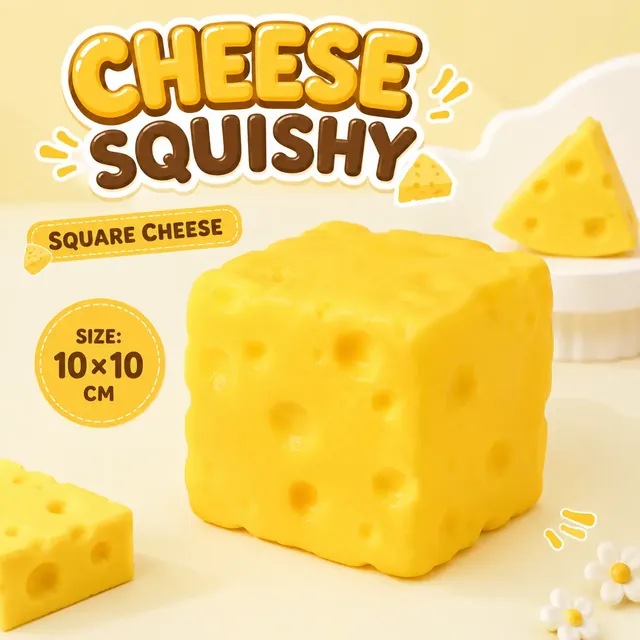
The 10 × 10 cm label identifies the larger square reference. Its broad front and top surfaces show the cheese-hole pattern. Keep the recognizable front above a tray or counter label; confirm actual packed footprint before allocating display space.
Small square reference

The 5 × 5 cm label distinguishes this square reference from the larger one. Because the silhouette is similar, give the size or confirmed variant a visible stock label; a thumbnail alone may not communicate the difference.
Triangular reference

This reference shows a wedge outline and a 7 × 6 × 4 cm label. A front-and-side view communicates the shape difference more clearly than a close-up of the surface holes.
Medium square reference
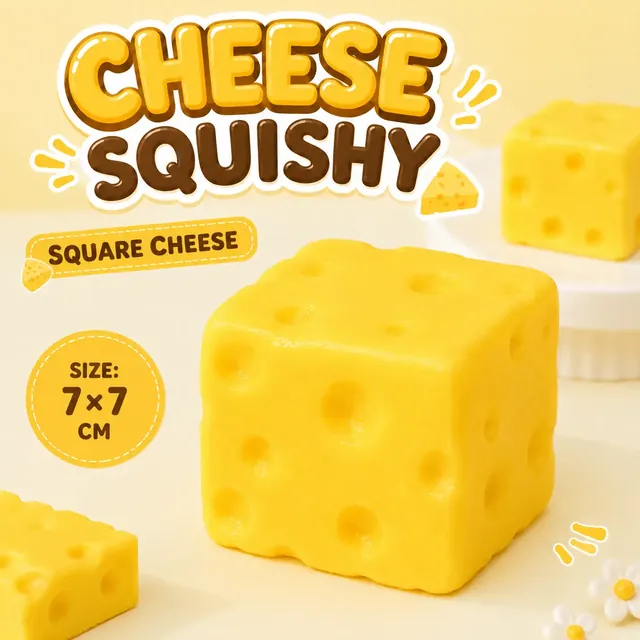
The 7 × 7 cm label identifies another square reference. If you stock all three square versions, compare them together beside a scale reference; these separate illustrations do not show their relative sizes at one shared scale.
The square artwork gives two marked dimensions, not a complete three-axis specification. These images do not establish each variant's filling, weight, scent or recovery, and the family name does not specify the retail set contents.
Look closely at the details that communicate cheese
Compare the outline, color and surface detail of each sample. The strongest option for your shop is the one that remains recognizable in its intended display, not necessarily the one with the most detail in a close-up photograph.
A deep tray can hide the lower part of a toy. A reflective bag can obscure small surface features. Test the finished package at the viewing distance shoppers will use, then check whether the price label or a neighboring product covers the recognizable side.
You do not need elaborate props to explain the shape. A consistent background and a clear front view often make comparison easier. Keep the presentation visibly associated with toys rather than implying that the product is food.
Review feel independently of appearance
A cheese shape does not establish a filling material, recovery speed or fragrance. RUIWO's Cheese Squishy product page lists TPR skin and flour filling for the current product family. Match that reference to the ordered variant and approved sample; recovery and fragrance still require their own evidence.
Press the approved sample in the intended manner and observe the response after release. Record the surface feel, resistance and recovery behavior using descriptive language. If you need a precise material statement for your listing or package, obtain supporting product information instead of inferring it from a photo or the product name.
Use the same approved version when making your product video. Switching samples between photography and filming can leave customers with two different impressions of the item they are ordering.
Decide how much variety the display needs
One cheese style may be enough when it serves as a single food-themed addition to a broader toy range. Several styles make more sense when shoppers can easily see their differences and staff can manage the variants accurately.

Before requesting a multi-style order, answer four practical questions:
- Can customers identify each option without opening every package?
- Can staff match the chosen style to the correct stock code?
- Does each option justify its place in the display?
- Can slower styles be reordered in different quantities from stronger ones?
For a wider assortment, pair the cheese theme with clearly different food shapes and use the food squishy display guide to plan the layout. Keep individual product identities visible even when the display shares one theme.
Should the package show all four styles
It can show the collection, but the actual contents of the selling unit must remain clear. A collection image should not lead customers to expect four pieces when only one is included.
Can all cheese squishies use the same description
Use shared wording for the theme, then describe the verified differences by variant. Avoid carrying a material, scent or recovery claim from one version to another without checking it.
Ask RUIWO about the current cheese styles and include your preferred version, quantity and packing format so the offer matches the product you intend to sell.