
Read this article in another language
Short answer: Links refer to this article. Existing localized editions may differ from the source. Unavailable languages are not translated pages.
OEM, ODM and private label are often used loosely in toy sourcing. Buyers sometimes treat the three labels as if they describe fixed packages, but in practice the commercial reality depends on a simpler question: how much of the product already exists, what exactly will change, and who controls the design, tooling and final specification?
On this page
- Choose the sourcing scope by what changes on the actual toy
- Private label: start with an existing product
- ODM: adapt a supplier-developed product
- OEM: manufacture to a buyer-controlled specification
- Check the commercial limits before choosing
- Clarify tooling ownership before paying
- Keep intellectual-property rights separate from manufacturing
- Use a staged sample process
- Which model is best for a first squishy toy order?
Choosing the wrong sourcing model can create unnecessary tooling cost, a slow launch, weak exclusivity or confusion about compliance responsibility. The right model should match your sales forecast, brand strategy, target launch date and tolerance for development risk.
Choose the sourcing scope by what changes on the actual toy
Write the requested change beside a specific starting product or design file. Then ask the supplier to confirm what remains standard and which new deliverable you must approve. This makes the project comparable even when two suppliers use OEM and ODM differently.
| Your intended change | Useful working description | Approval the brief needs |
|---|---|---|
| Add your brand to the box; keep the toy unchanged | Existing product with private-label packaging | Exact base SKU, retained product specification and packaging artwork |
| Adapt a supplier-developed toy with an agreed change to color, decoration or feel | Modification of a supplier design, often described as ODM | A written list of changes and a physical sample for any change that affects the product itself |
| Produce a new shape against your controlled design | Buyer-specified development and manufacturing, often described as OEM | Design revision, dimensional requirements and the stages needed to reach an approved production sample |
Hypothetical decision: A gift-shop brand wants a mascot launch. If the mascot appears only on the box around an unchanged catalog toy, the initial brief can remain a packaging project. If the toy must reproduce the mascot's silhouette and proportions, the supplier needs to assess a new product design. Calling both requests “private label” would obscure the difference in development work. A change from one filling to another also needs its own feasibility and sample review; an unchanged outside shape does not establish an unchanged product specification.
Send the two alternatives as separate requests if you have not decided: one for the existing toy with approved packaging, and one for the original shape. Ask for the deliverables, order conditions and approval sequence for each. Compare those answers before combining them into one launch plan. Use the mold and tooling guide once a route requires development; use the manufacturer versus trading company guide to decide who will manage the work.
Private label: start with an existing product
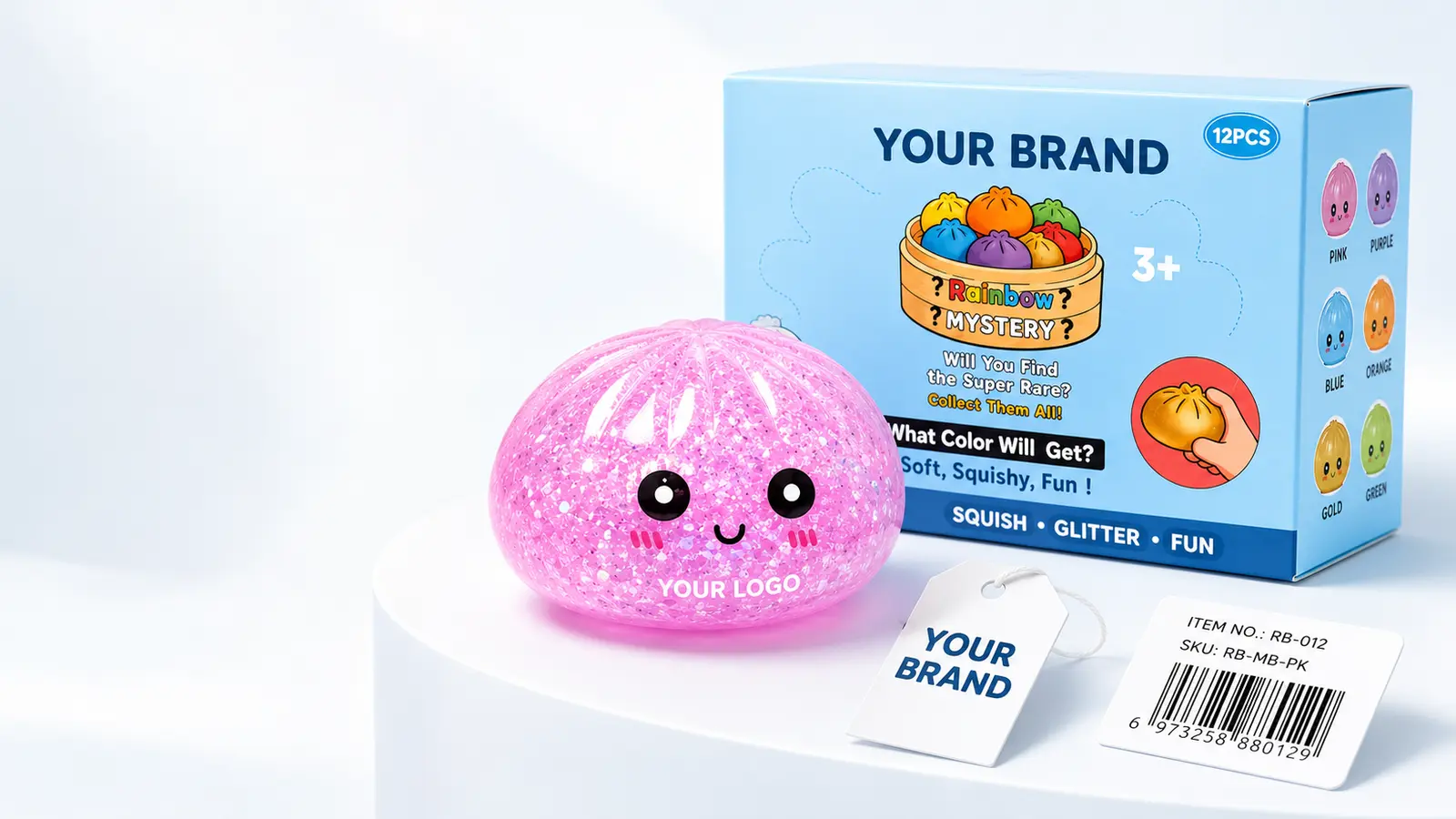
A private-label project usually begins with an existing product that is already in the supplier's catalog or production system. The buyer adds brand elements such as a logo sticker, hang tag, barcode, printed card, retail box or display packaging.
This route is often useful when:
- You want to test a market quickly.
- You do not need a unique shape or mechanism.
- Your initial volume is moderate.
- Brand presentation matters more than product exclusivity.
- You want to avoid new tooling at the beginning.
Keeping the base product unchanged can reduce development work. The actual schedule still depends on available stock, sample approval, artwork, packaging components and the quoted production plan; private label is not a guaranteed fastest route.
The main limitation is exclusivity. Unless there is a specific agreement, the same or a very similar base product may be sold to other buyers.
For many first-time toy brands, private label is a sensible validation step before investing in a fully custom product.
ODM: adapt a supplier-developed product
ODM usually means the supplier already has the core product design and allows the buyer to modify selected elements. In squishy toys, this can include color, printed decoration, filling, scent, packaging, accessories or an approved variation of an existing shape.
ODM can reduce development time because the base product has already been engineered. However, buyers should not assume that every modification is simple or low-MOQ. A new color may be easy. A new mold, structural change or different material may create a separate development path.
Before approving an ODM project, ask:
- Which parts of the design belong to the supplier?
- Which changes can be exclusive?
- Does the modification require new tooling?
- Who owns any new tooling that you pay for?
- Can the supplier sell the unchanged base design to other customers?
- Does the modification affect testing or product documentation?
The commercial value of ODM is not the acronym itself. It is the ability to launch a differentiated product without starting every technical step from zero.
OEM: manufacture to a buyer-controlled specification
OEM is more appropriate when the buyer controls the product concept or technical specification and needs the manufacturer to produce it accordingly. The project may involve original drawings, dimensions, 3D files, new shapes, new tooling, special materials, custom packaging and multiple sample rounds.
OEM is usually chosen when:
- A unique product is important to the brand.
- The buyer expects enough sales volume to justify development cost.
- Product exclusivity matters.
- The buyer can manage a longer development process.
- A detailed specification and approval workflow can be maintained.
For squishy toys, a true OEM project may require mold development, texture and color confirmation, material/filling selection, sample revisions, packaging tests and final compliance review.
The buyer should treat the approved sample and written specification as one controlled production standard. Do not rely on chat messages alone to define the final product.
Check the commercial limits before choosing
Use the route table with your available budget, realistic order quantity and required receiving date. Request a schedule with explicit sample, artwork and production-release conditions instead of ranking routes by an acronym.
- Budget and demand: separate one-time development from recurring goods and packing costs; compare the quantity you can support with the actual minimums.
- Rights and scope: specify which design elements, tooling and permissions the agreement covers. A branded box does not itself create product exclusivity.
- Approval capacity: name who reviews product revisions, packaging and destination-market evidence. A changed material or component needs a version-specific review.
These checks make the alternatives comparable without assuming that every OEM job is slower or every ODM modification is minor.
Clarify tooling ownership before paying
If tooling is required, the commercial agreement should state:
- Who paid for the tool.
- Who legally owns it.
- Where it will be stored.
- Whether it can be used for other customers.
- What happens if the supplier relationship ends.
- How maintenance or replacement is handled.
Do not assume that paying a mold fee automatically answers all of these questions.
Keep intellectual-property rights separate from manufacturing
A factory can manufacture a product without being responsible for whether the buyer has rights to a character, logo or design. Buyers should ensure they have permission to use all branding and artwork supplied to the factory.
For supplier-owned ODM designs, ask whether the design is non-exclusive, territory-limited or available for exclusivity. Use written terms rather than verbal assumptions.
Use a staged sample process
A practical development workflow is:
- Confirm the product brief.
- Choose OEM, ODM or private-label scope.
- Confirm target quantity and packaging.
- Approve a reference sample or prototype.
- Lock dimensions, color, material and decoration.
- Approve artwork and packaging.
- Confirm compliance scope for the final version.
- Place the production order against the approved specification.
The sample approval guide can help turn this into a repeatable buyer checklist.
Which model is best for a first squishy toy order?
There is no universal answer, but a practical sequence for a new brand is often:
- Start with ready-stock or private label to test product-market fit.
- Move to deeper ODM customization after identifying winning shapes and price points.
- Invest in OEM and new tooling when sales data justify exclusivity.
This keeps early inventory risk under control while preserving a path toward a more differentiated product line.
Ruiwo Toys supports ready-stock wholesale, private-label packaging and custom/OEM squishy toy projects. Review the custom squishy toy service, compare current products in the wholesale catalog and contact Ruiwo Toys with your target quantity, product concept and destination market.