
Read this article in another language
Short answer: Links refer to this article. Existing localized editions may differ from the source. Unavailable languages are not translated pages.
The quantity on a squishy toy RFQ should describe the unit used for pricing. If the catalog price is per piece, enter the number of individual toys. Write the display-box count, carton count and desired style mix separately. A product name containing “set” or “six styles” does not, by itself, mean that one quoted unit contains six toys.
On this page
This distinction matters when a buyer selects several colors, compares suppliers or asks for a revised quote. Ten display boxes, ten retail sets and ten individual pieces can represent very different orders. Agree on the unit before comparing totals.
Separate the four quantity levels
- Piece: one individual toy when the price basis is per piece.
- Retail set: a defined group sold together to the final customer. Record every component and the number of pieces in the set.
- Display box: a presentation pack holding sale units. Its contents may be sold individually or together; confirm which arrangement applies.
- Master carton: a shipping container holding individual units, displays or other inner packs. Confirm the contents for the selected size and packaging.
Keep these levels as separate fields in your order sheet. “Quantity: 24” becomes actionable only when the supplier knows whether it means 24 pieces, sets, displays or cartons. For mixed purchases, use one line for each product and selected variant rather than a single total for the entire shortlist.
Read the price unit before the product name
Look for the unit beside the price and in the quotation. A collection photograph can show several colors without promising one of each in every package. Likewise, a family name can cover several sizes that use different prices or carton arrangements.
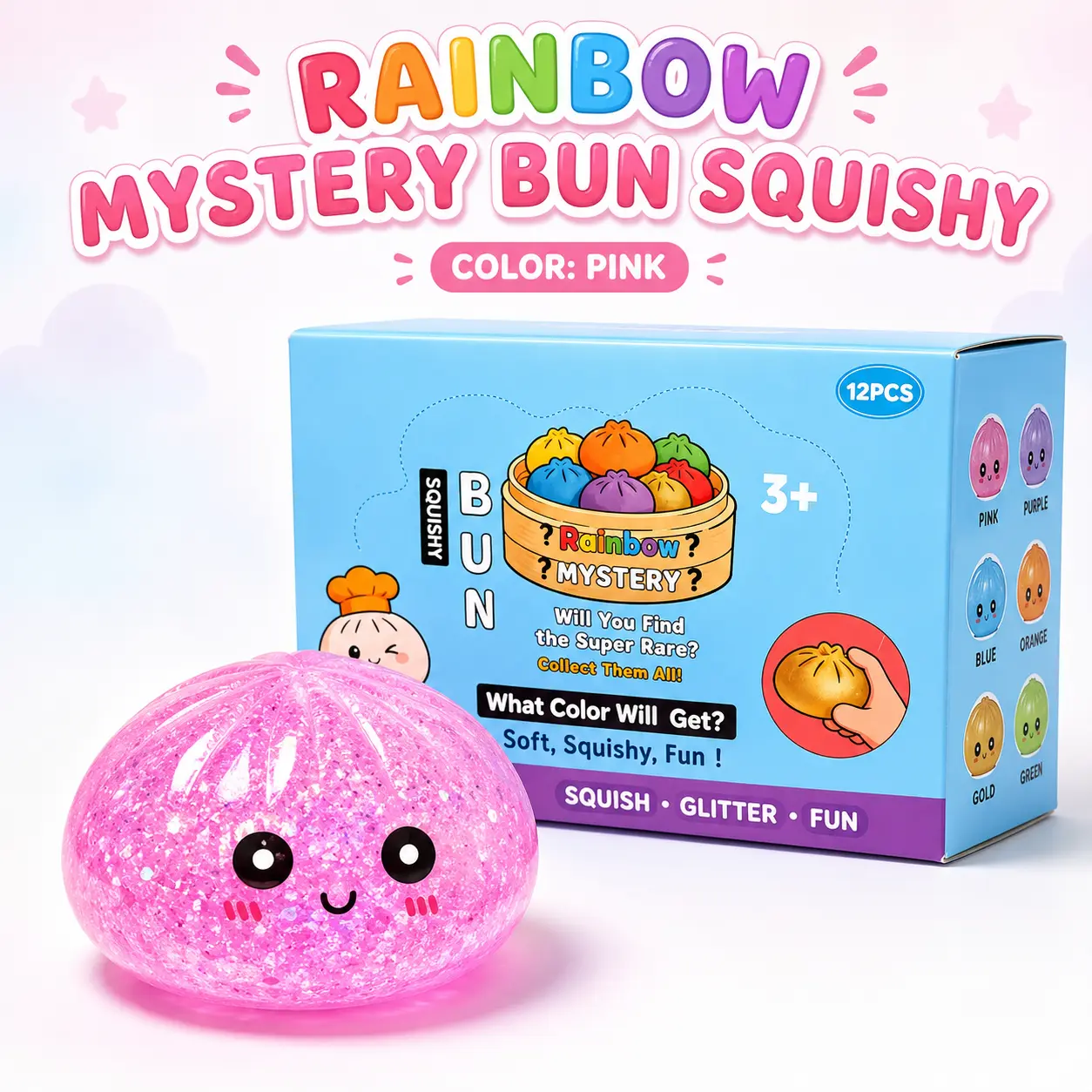
The Rainbow Mystery Bun product page illustrates the distinction. Its current catalog reference uses a per-piece price, lists two sizes and six colors, and describes a 12-piece display. Those are different pieces of information. Confirm the selected size, the color allocation and the packing version before converting your required displays into pieces.
A worked display-box calculation
Using the catalog's 12-piece display reference, a buyer planning ten displays would calculate:
- Required displays: 10.
- Pieces in each approved display: 12.
- Total individual toys: 10 × 12 = 120 pieces.
- Requested color allocation: written separately and subject to confirmation.
This is a planning example, not a minimum order or a promise that 120 pieces can ship as a standard carton. The same product page gives different carton references for its two sizes. The supplier must confirm whether your requested quantity needs full cartons, a partial carton or revised packing.
If a buyer wants six colors in equal quantities across 120 pieces, the proposed total is 20 pieces per color. That does not automatically mean every display contains two of each color. Specify whether the ratio applies to each display or to the order as a whole.
A worked retail-set calculation
Suppose your own gift concept contains three individual toys in one retail set, and you need 40 finished sets. The component requirement is 40 × 3 = 120 toys. Ask the supplier to show the component quantities, set assembly and outer packaging separately in the quote.
If the supplier quotes the finished set as one unit, compare prices per finished set. If the supplier quotes components per piece, reconcile the three component lines before adding packing or assembly. Do not compare a per-set price directly with a per-piece price. The supplier quotation comparison guide covers the remaining price and delivery assumptions.
Copy these fields into your RFQ notes
- Supplier SKU and product link.
- Exact variant, size or color reference.
- Quantity entered on the RFQ and its pricing unit.
- Pieces per retail set, if you are building a set.
- Sale units per display and required display count.
- Requested quantity by color or character.
- Whether the ratio applies per display, per carton or to the total order.
- Standard or custom packaging and destination country.
- Whether substitutions or partial cartons are acceptable.
Enter a positive whole-number quantity for every product on the RFQ form. Use the notes to explain any set or display requirement. When the selected product is priced per piece, put the total pieces in the quantity field; do not enter the number of displays as though it were the piece count.
Recheck the unit after a quantity change
A revised order may change the number of full displays or cartons. Recalculate the component total and color allocation, then ask for updated packing and freight information. Keep the latest quotation with the agreed unit and quantity so your receiving team checks the same order that you approved.
Start with the wholesale squishy catalog to select products. For a seasonal mix, compare the Halloween range, then send the SKU list and quantities for confirmation.