
Read this article in another language
Short answer: A practical B2B guide to selecting fidget keyboard formats, comparing samples and planning packaging for wholesale resale.
For most gift and stationery retailers, 1–4-key keyboard keychains are the impulse range, a 9-key style adds a stronger multi-button experience, and a 26-key board works as the desk or shelf feature.
| Format | Retail role | Tactile experience | Typical presentation |
|---|---|---|---|
| 1–4 keys | Checkout, peg or bag accessory | One quick press or a small group of repeated presses | Hang card or OPP bag; final pack by SKU: [工厂确认] |
| 9 keys | Counter tray or small desk gift | Several buttons in a compact footprint | Keychain or compact retail pack; packed data: [工厂确认] |
| 26 keys | Desk, shelf or feature display | Longer interaction with a board-like layout | Color box or shelf-ready pack; packed data: [工厂确认] |
Use one row per SKU in the buying record. Unit weight, exact package and carton count for each selected version are [工厂确认]. Request a keyboard comparison.
Fidget keyboards are tactile novelty toys. The best opening range links key count, switch feel, light function and selling unit to the place where the product will be displayed. A small keychain creates an easy impulse purchase; a larger board earns shelf space by giving shoppers more interaction to try.
On this page
Choose the key count for the display
Start with one compact format, one mid-size format and one feature format when the store has room for a three-step range. The 1–4-key group is easiest to hang or place beside the checkout. A 9-key style gives a clearer multi-button experience without the footprint of a full board. A 26-key style is better suited to a desk, gift section or shelf feature.
Online sellers can show several formats on one comparison page, while a small physical shop usually gets a clearer result from three distinct selling units. Record sell-through separately by key count so the next order follows the format customers actually choose.
Match switch feel to the customer
Clicky mechanical-style switches make a distinct sound and give a sharp press-and-release action. Tactile switches give a bump with a softer sound, while linear switches move smoothly with little sound. The switch type used by each current SKU is [工厂确认]; record it with the sample instead of using “keyboard” as a substitute for a switch specification.
| Switch direction | Feel and sound | Good fit |
|---|---|---|
| Clicky | Clear click, defined actuation | Gift counters, novelty demonstrations and sound-led videos |
| Tactile | Noticeable bump with a softer click | General gift and stationery displays |
| Linear | Smooth, quieter travel | Shared desks, classrooms and quieter retail environments |
Record key travel, press resistance and return feel after the sample reaches room temperature. A sound-led listing should use the same SKU shown in the video.
Separate light-up and non-light versions
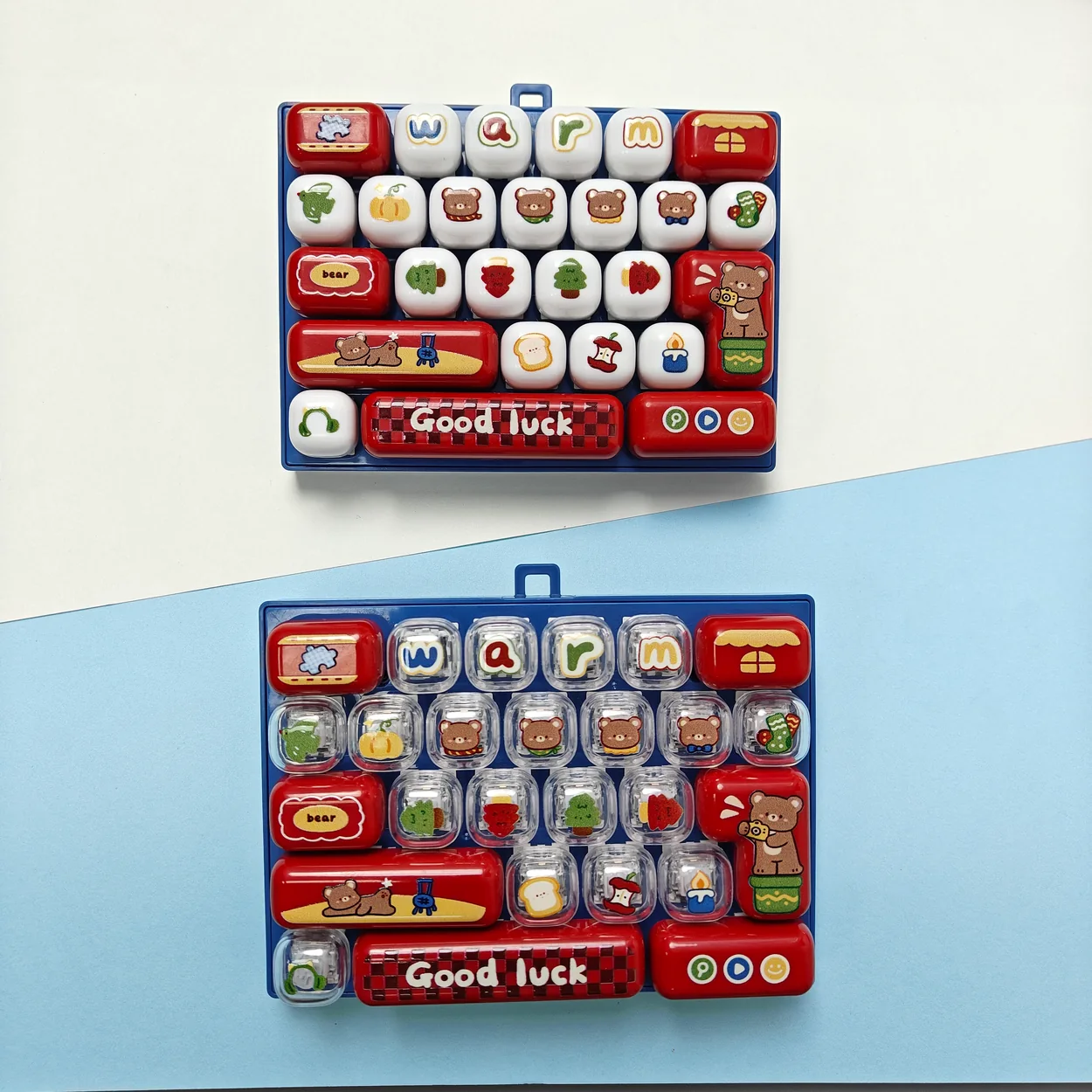
Light-up and non-light keyboards are different selling units. The catalog identifies LC-01 as a non-light one-key version and LC-02 as a light-up one-key version; LC-39 is Pastel · Non-light and LC-40 is Pastel · Light-up. Keep each version on its own SKU row and product image.
Light-up versions add an operating step, a power configuration and a battery or charging record. Power type, battery details and run time for each current model are [工厂确认]. If the product uses a small battery, keep the battery compartment, age grading and transport documents with the SKU record.
Use the package as part of the product choice
Keychain formats commonly work in an OPP bag or on a hang card because the hook and front view matter at checkout. A multi-key board usually needs a box or protective front panel so the keys are not pressed during handling. The final packed length, width, height, unit weight and carton count are [工厂确认].
- Hang display: leave room for the hook and keep the key action visible.
- Counter tray: use a stable base and a clear unit price.
- Shelf display: protect the larger board and show the key count on the front.
- Online parcel: measure the finished selling unit before selecting an outer mailer.
Keep barcode space, product identity, warnings, age grade and responsible-party information with the approved pack artwork. A removable keycap or decorative part is a small part and needs the warning language required for the destination market.
Build a controlled opening assortment
A practical first range is one 1–4-key keychain, one 9-key style and one 26-key feature board. Add colors or characters only when the display can show the differences clearly. Keep light-up, non-light, transparent and solid versions separate in the sales report because the customer experience and pack data can differ.
Use a mixed sample set to compare one example of each selected format. Record the sample ID, key count, switch direction, light function, package, photographs and observed feel. Sample cost and dispatch timing for a selected set are [工厂确认].
Check the common quality points
| Issue | What it feels or looks like | Useful sample check |
|---|---|---|
| Key does not return | Cap stays low or returns slowly after a normal press | Press every key repeatedly and record any key that behaves differently |
| Key sticks | Rubbing, uneven travel or a cap that catches at one edge | Press from the centre and each corner of the cap |
| Keycap loosens | Cap lifts or rattles during normal handling | Inspect attachment after the planned demonstration and packing test |
| Light does not work | No light, flicker or inconsistent switch response | Run the light function with the supplied power configuration |
| Decoration wears | Print or coating rubs at a high-touch point | Compare the approved sample with the packed sample after handling |
Do not market a fidget keyboard as a functional computer keyboard unless that function is specifically designed and documented for the product.
Write the wholesale request around one SKU record
Include the target market, sales channel, key count, selected SKU or format, light function, color mix, unit package, quantity and required receiving date. Add the switch direction, packed dimensions, carton data, production estimate after approval and available product documents. This keeps a 1-key keychain from being compared with a 26-key board on unit price alone.
Use the keyboard price and retail margin guide for the commercial calculation, the light-up version guide for version control and the sample and order process for approval records.
FAQ
Which key count should a retailer start with?
Start with one 1–4-key keychain, one 9-key style and one 26-key feature board when the fixture allows three selling units. Reorder by measured sell-through.
Are clicky switches suitable for every store?
No. Clicky switches suit sound-led demonstrations; tactile or linear switches are more comfortable for shared desks and classrooms. The actual switch type remains SKU-specific.
Can I request a mixed sample?
Yes. A mixed sample can include one example of each key count or light version. Sample cost and dispatch timing for the selected set are [工厂确认].
What should I do when a key sticks or a light fails?
Separate the affected SKU, record the key count and power version, photograph the problem and compare it with the approved sample. The next production or replacement decision should use that same SKU record.
The strongest keyboard order connects the tactile sample, selling unit, package, safety information and carton data before the quantity is released.